
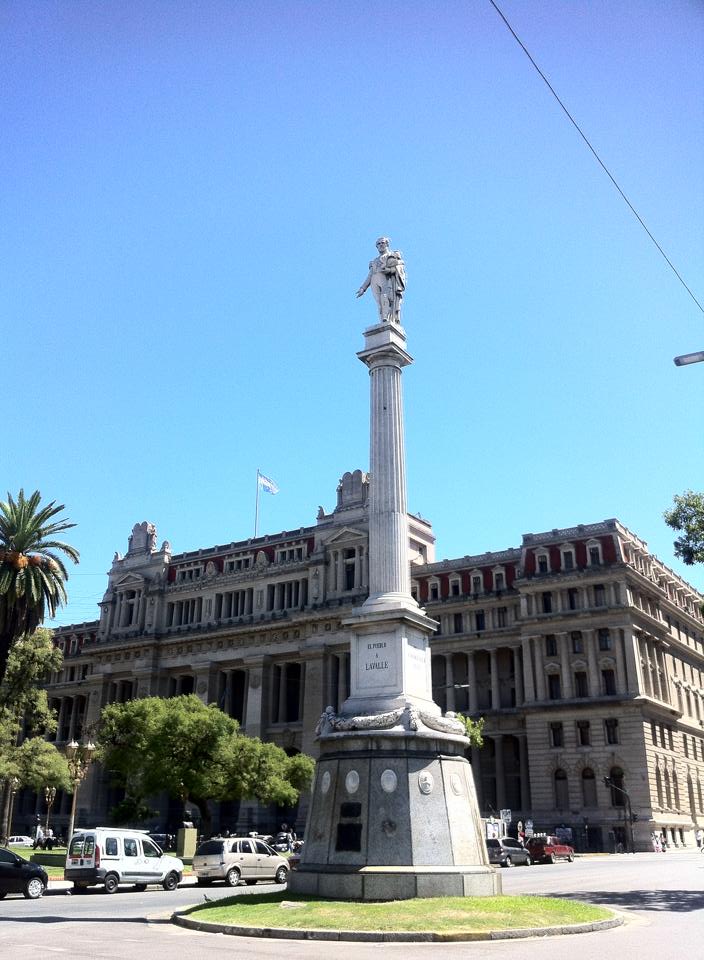
Buenos Aires: The Paris of South America
Full Disclosure: I have never been to Paris. Buenos Aires being described as “Paris of South America” is a very popular phrase that comes up when you research the city, but if the point of this nickname is to refer to how European it is, then it is very correct.
When I walked along the tree covered streets of Buenos Aires, I really did feel as though I was in Europe. The people, architecture, and general environment are all heavily influenced by the large Spanish, French, Italian, and Eastern European groups of immigrants that have come to form what the city is today. While you may expect see all monuments to people with Spanish surnames, there are a great deal of very public monuments that are dedicated to Italian, French, Polish, English and Arab citizens of Argentina all throughout the city. Even though the country is majority Catholic, it is not unusual to see Jewish, Muslim, or other Christian places of prayer. In fact, I got to visit the LDS Temple on the outskirts of the city and it was unlike any other I have ever seen. The point I’m trying to make it that Buenos Aires really is a melting pot of different people, and I didn’t see any signs of prejudice against people because of their religion or race.
Getting There
If you are an American, Australian or Canadian citizen, there are a couple of hoops you are going to have to jump through before going to Argentina, but likely nothing like Brazil. Yep, say it with me now: RECIPROCITY. You will have to pay a fee of $160 USD, if you’re American (I’m not sure what it is for Canadians or Australians) and have a receipt printed out before you can even get your boarding pass. I got to the airport in Brazil three hours before my flight and by the time I made it through the line to get to the counter, I was surprised by the insistence of the airline employee to see it. Luckily, the manager was an angel and printed the paper for me (Interesting fact: I was never asked for the receipt by any Argentine official).
Currency
The Argentine Peso (ARS) has an official rate of $1USD for every 8.9 ARS (approximately). I say “official” because there are people who will exchange your US Dollars at a rate of 1:12, but beware: these people aren’t in any kind of official capacity. If you get ripped off, you have no recourse. I didn’t use them, but I was propositioned many times by people on the street and it just didn’t feel right. Come to find out, often times these people will slip in counterfeit bills with the real ones, or just take you around the corner and rob you. I wouldn’t suggest it.
The People
The people are very nice, very fashionable, and seemed to be very educated in etiquette and languages. That being said, they call this the “Paris of South America”, so what would any good Francophile society be without having “higher standards” (I’m being a little sarcastic here). There are some people in Buenos Aires who just think they are better than everyone, as every city has, but they do it big here.
Also, I keep bringing up the European appearance of people, but it was very surprising for me. When you think South America, there’s a certain image that came to mind before I visited, and this was not it at all. Even compared to Rio, there seemed to be much more people that were from Europe. I mean I saw red hair and freckles on a daily basis; not the normal appearance for the city, but just to illustrate my point.
The Food
As a good friend of mine said when he found out I was going to Buenos Aires: “Eat lots of steak. If they ask you if you want chimichurri with it the answer is 1000x YES.” He was not wrong. The first bit of steak I had there was actually from a father/son street vendor team. The steak sandwich was grilled fresh in front of me and it cost right around $2USD. It was amazing! Some of the best steak I have had in a while. Other than steak, you can find anything you are looking for. I would suggest you check out any pizza before you buy it though, because this is one area that Argentine cuisine is definitely lacking (as a whole) in my opinion.
The Places
Palermo: Any of the Palermo neighborhoods is a lot of fun. They are colorful, full of artists, and a favorite amongst tourists and the “hip” fashionable types. A lot of fashion stores here are actually on the same level as their European counterparts, but less known and much less expensive. Palermo is also a great location for nightlife. Keep in mind, the “nightlife” doesn’t begin until at least 11pm. Some bars and clubs don’t open until 2am on Fridays and Saturdays. Also, don’t think these locations are all techno or hip hop, there are plenty of relaxing wine bars…and the wine from here is world famous.
Teatro Colon: This amazing theater is well worth the 180 Pesos it costs to take the tour. The esthetics, history, and acoustics of this place are amazing. You hear stories of the drama that took place with the architects and painters, as well as why the positions of your seat meant so much. I really felt as if I was being told the story of a soup opera, rather than an actual opera house, but it was all very entertaining. More info here.
Casa Rosada: The “Pink House”. This takes up the whole East Side of the Plaza de Mayo. It is a really interesting sight and kind of weird. I like weird though, because what’s normal?
Plaza de Mayo: Since you came here to see the pink house, you might as well explore the rest of the plaza. This is the home to many of the city government buildings and looks great all lit up at night. No worries about the safety issue at night, plenty of security around.
Tango: You can’t come to Buenos Aires and not enjoy the tango, in one form or another. There are plenty of street performers around the city, as well as whole institutes dedicated to the tango.
Conclusion:
I wish I had more time in Buenos Aires. This place really surprised me. Warm weather, but not much humidity. Beaches. Friendly people. Fun nightlife. Very European. I like it and I recommend it for anyone.
You Are Awesome!
-Mike
Comments? Questions? Suggestions? Please leave them down below.
 Mike The Migrant