
 Before I start talking about my time in Poland, you need to know I am biased. My mother’s maiden name was a Polish Surname. Some of my family have studied and lived in Poland. One of my best friends is from Poland. I knew what gołąbki was long before I stepped one foot into Poland. Yeah, I pulled the gołąbki card. Point being, I may not come across as the most impartial observer in this post…But do I ever really?
Krakow
Krakow was home base for my month long excursion into Southern Poland. With a population of over 700,000, Krakow is the second largest city in Poland, and oldest large city in the country. When I stepped off the plane from Rome (Late March), I realized this was also going to be a colder adventure than I was used to, with lows being in the 20s and highs being in the low 60s. After the initial shock wore off, the amazingly warm-hearted people of Krakow were able to warm me up quite a bit. You see, not only are people in Poland world renowned for their good looks, but they are also some of the kindest and strong willed people you will ever meet. Their great food and home made liquors helped to take my mind off of the cold, as well.
More info: Here
What to see in Krakow:
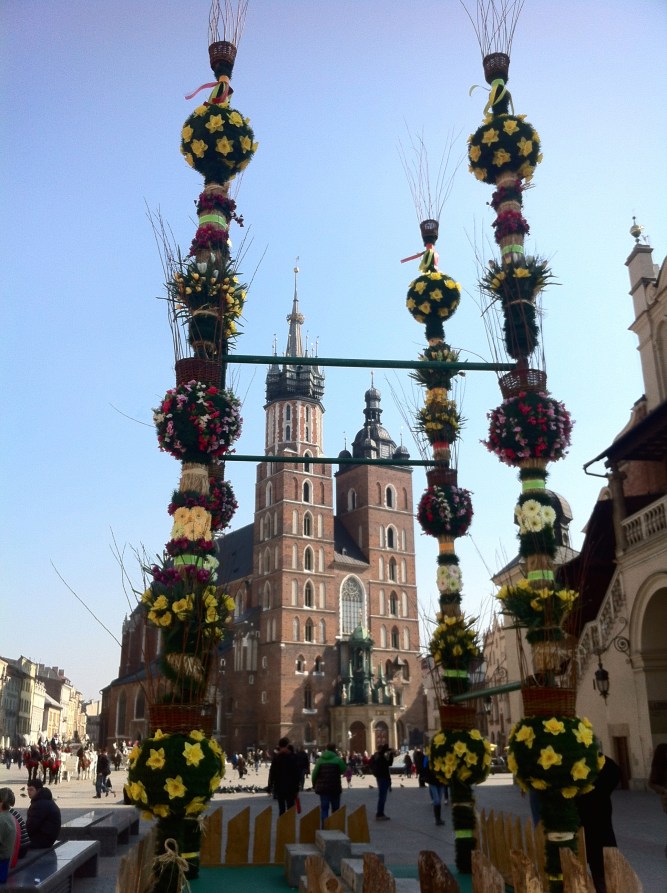
The Main Square of Old Town Krakow. Since the 13th century, this has been one of the most active places in Krakow and is the largest medieval town square in Europe. You can see St. Mary’s Basilica, the Adam Mickiewicz Monument, underground museum, Town Tower, and plenty of commerce (especially bagel salesmen) going on in this lively area.
More info: Here
Restauracja Jama Michalika, on the recommendation of my Aunt. This place has it all: location, ambience, great service, and of course great food! Started with the Żur Staropolski (Sour soup. It has halved eggs, sausage, onion, garlic, and parsley). Półmisek pierogów (dumplings) for the main course. Then a dessert liqueur (which I didn’t ask for, but they had “extra”), some green tea, and some kind of amazing cake (I don’t know what kind, but you don’t offer a fat kid cake and expect it be turned down. I demolished it!).
More info: Here
The Old Synagogue. Built in the early 15th century and is the oldest standing synagogue in Poland. This Orthodox Jewish synagogue is not only an important symbol to Jews, but to the whole of Poland. In 1794 General Tadeusz Kościuszko (military hero in Poland and the USA) gave a famous speech to gain Jewish support for Polish independence at the synagogue. During Nazi occupation, the synagogue was unfortunately ransacked and the site of 30 Polish Jews being executed. With the building surviving so much, it is a true testament to the resiliency of the Polish and Jewish people.
More info: Here
Schindler’s Factory/ Krakow under Nazi Occupation 1939-1945 Museum. The museum shows Krakow life prior to invasion, during Nazi occupation, and subsequent liberation. This museum goes very in depth as to different view points on the war. Very graphic images are included, but I refuse to show them.
“If I had to put up a poster for every seven Poles shot, the forests of Poland would not be sufficient to manufacture the paper. ” – Hans Frank, Nazi Governor-General of the occupied Polish territories, and all around asshat. To put that in perspective, one tree averages over 8,000 sheets of newsprint sized paper and Poland is covered in forests. More info: Here
Food: Zapiekanki from Plac Nowy in Kazimierz (Jewish Quarter), Twister Pizza, and Kielbaski pod hala targowa. Mmm. Locals in Krakow know about these places, and I’m letting the cat out of the bag. YES. DO IT. ‘Nuff said.
Studio Tańca Sihir. If you will be in Krakow for an extended time, make sure to stop by Sihir to learn some dance moves. The owner, Rozalia, is a world class dancer (ranked as such) and is a friend. She can help you with all of your dancing needs.
More info: Here
What to see in Częstochowa: I recommend taking the under 2 hour train here, as the trains in Southern Poland are quite efficient and CLEAN (even the toilets). While the main attraction in the city is the monastery Jasna Góra, home of the Black Madonna painting. This painting, like most famous icons in Poland, has a contested history and many legends attached to it. Some say this was painted by St. Luke at the home of the Holy Family, while other will say that Helena found the painting and brought it back to Constantinople for her son. The true history may never be known because it has been painted over and moved so much. On several occasions throughout history this painting has been credited with saving the monastery, leading to name the Black Madonna as “Queen and Protectress of Poland.” Besides the religious aspect of the town (which is everywhere), there are some cool public art, parks, and unique shops all throughout.
More info: Here
What to see in Wieliczka:
The Wieliczka Salt Mine is a salt mine in existence since the 13th century, containing numerous statues, chapels, living quarters, lakes, and mining equipment (obviously). This place is amazing and the list of visitors reflects as much: Nicolaus Copernicus (first VIP visitor), Johann Wolfgang von Goethe, Fryderyk Chopin, Karol Wojtyła (later, Pope John Paul II), former U.S. President Bill Clinton, and many other well known people. There are two schools of thought on the creation of the salt mine, stemming from science or legend. Scientists believe that approximately 6,000 years ago salt started evaporating on the surface of where Wieliczka is today and people have just kind of kept digging in that general area every time salt ran out from the surface. Legend says Hungarian Princess Kinga asked her father for a lump of salt as a wedding gift for the Prince of Krakow. The king took his daughter to a salt mine in his kingdom and she threw her engagement ring to the bottom of a shaft. When she got to Poland, she told some miners to dig a hole, and at the bottom they found a rock containing salt and her engagement ring. Train or bus will work for getting here, but train is less confusing.
More info: Here
What to see in Oświęcim:
Oświęcim, better known by the German name Auschwitz. Auschwitz was a name given to three camps in Poland that was used to humiliate, torture, experiment on, and murder over 1.3 Million people during World War II. After Nazi Germany had claimed the area, the first camp started out for Polish citizens seen as a threat to the Nazis. The “Death Wall” was just the beginning for all of the death. The camp then grew to take in “threats” from all throughout Europe. Experiments in sterilizing Jews and Slavs took priority in some buildings, while others housed the “courts”, and every thinkable torture and murder happened. After the Nazis found out that a common chemical used for killing rats and lice could be used to kill up to 2,000 people in 15-20 minutes, the operations ramped up substantially. Jews from all across Nazi occupied Europe were told to pack all of their belongings, that they were being offered “new jobs and homes” by Nazi Germany. After arriving to Auschwitz, these people had all of their possessions taken. The gold, money, and high end items were sent to Germany, while all of the other items were placed in warehouses on site. Nazi doctors would separate the strongest from all of the rest. The strongest were going to the concentration camp (average life span of 3-6 months) and the rest were exterminated.
What to see in Zakopane: Zakopane, Poland. Located in the South of Poland, Zakopane is at the base of the Tatra Mountains, which is the natural border with Slovakia. Though there was snow all around (early April), the temperature felt warmer than Krakow. While you are here, be sure to take a stroll through the large market, get up on the mountains, and MAKE SURE to try the serek z grilla (grilled cheese) made with Oscypek (goat) or Gołka (cattle) cheese. Both are delicious!
More info: Here
You Are Awesome!
-Mike
Comments? Questions? Suggestions? Please leave them down below.
 Mike The Migrant